

From Books to the Big Screen: How Alum Daniela Schrier Kafshi ’04 Crafts Stories That Matter
April 30, 2026
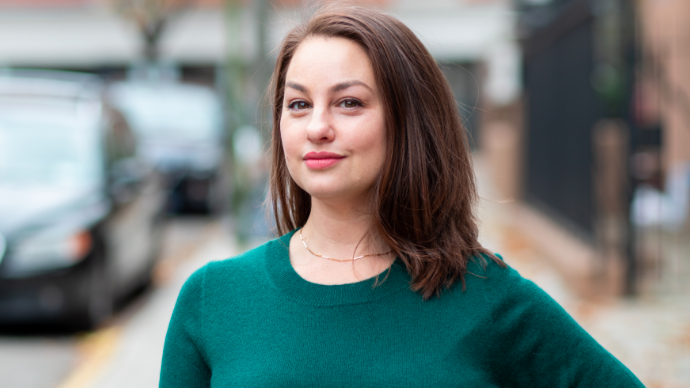
The filmmaker discusses her career path, creative work and how her degree in English shapes the way she crafts a story.
By Chelsea McLin M.A. ’19
The day after a gunman opened fire at an elementary school in Uvalde, Texas, Daniela Schrier Kafshi sat down and poured her fury into a nearly complete screenplay. The result was “Ladybug,” a short film that explores a mother’s grief in the aftermath of a school shooting through a blend of comedy and raw emotion. Since premiering in 2024, the film has screened internationally, earned a nomination for a Female Focus Film Award and won Kafshi a Best Director prize at the Cordillera International Film Festival.
From reporting on international news in D.C. to creating thought-provoking films, storytelling has always been central for Kafshi, who credits her English studies with shaping both her creative work and professional path.
We recently spoke to her about what drew her to English, how her career evolved and why she encourages anyone to start creating without waiting for permission.
What drew you to study English at the University of Maryland?
I came from a family of book readers. I grew up in a multigenerational home, and reading was just a big part of what a person did. From an early age, it shaped how I think. It taught me to be open-minded, caring and flexible.
In high school, I read “Song of Solomon” by Toni Morrison, and that really woke me up. I didn’t know contemporary literature could be that powerful.
I decided to study English because I valued being around people interested in literature and understanding why it matters. I felt it helped me understand myself and the world. I loved it.
How did your English degree prepare you for work after college?
My degree gave me strong writing and analytical skills and a foundation to work in all kinds of communication work. Before filmmaking, I worked in public relations, public affairs and journalism. I worked at Voice of America, a large international broadcaster, with people from all over the world reporting on news.
When I transitioned to becoming a full-time filmmaker, my English degree continued to support me. I think you can only write really good complicated characters from reading books. Literature can be complicated and push you to develop a deep relationship with characters. When you care about that level of world building, it translates to good filmmaking.
But being a filmmaker is not only about writing. There's building up your brand. You need to craft your director's statement and pitch decks. You need to meet investors and compel people to get excited about what you're doing. You need to unify a team. All that requires really good communication skills.
You knew you wanted to make films while you worked in PR and journalism. How were you nurturing that interest?
Yes, that was my dream, but making movies can be expensive. I started working in news because I wanted to use my hands and learn how to edit and get paid to do it. That was one of the building blocks to becoming a filmmaker. How do you take bits and pieces and turn them into a story? It made me a better director.
When I worked in journalism, I was in the trenches working with the camera and on the road. I traveled to the DNC convention during the Obama years. It created really good life experiences, which made me better at writing stories. I was able to get out into the world. I needed to have experience and step outside of my comfort zone. Whenever you're uncomfortable, whenever you're doing something that's really hard, that's when you're going to grow.
I was always developing as a creative, and all of those experiences informed my career as a filmmaker.
“Ladybug” follows a woman on the anniversary of her daughter’s death in a mass shooting. She commemorates the day with a wild act of justice. What inspired this story?
I had worked on some independent films. I run a boutique production company for marketing and branded content called Silverose Productions, but I took a hiatus when I had my first child. Then another school shooting happened, and I felt what I’ve called a kind of “holy fury.” I was angry and in utter disbelief. It was unfair.
Being a parent is scary, and it made me think about the parents who experience tragedy like this and nothing changes. I thought about what they might do and the pressure they would feel.
People don’t want to talk about school shootings, and that’s understandable, but the victims deserve for us to pay attention to them at least. So I sat down and wrote “Ladybug” in one go.
I wanted to approach it differently––even with moments of humor. That's one of the reasons why the main character breaks the fourth wall. I felt like it made audiences have to wait, pay attention to her, and see that the people who go through these tragedies are real. They're just like any one of us, and they're complicated.
It has kind of a shocking premise, but I don't want violence. I want people to move toward love, unity and forgiveness. It was important to me to create a story that ended in a way that we could talk about what happens when we don't choose violence, even though we are angry.

Still from "Ladybug"
You’ve said you’re drawn to “rabble-rousing” characters. What interests you about them?
Growing up, I identified with a lot of male characters—not because they were male, but because they were allowed to be messy and brave and unconventional. Now, I’m interested in creating female characters who are just as multidimensional. The women I know are like that. They speak truth to power, and they’re not afraid of hard conversations. I want to portray women who are not afraid to break the rules, and who are a reflection of my reality.
My next feature film, “Riding High,” is about a female cowboy in New Mexico. The American cowboy has forever been a male fantasy, but I think a lot of women relate to that idea of wanting to be free, being with their animals and doing their own thing.
What advice would you give to English students interested in film or screenwriting?
Don’t wait for anyone’s permission. You already have the tools—your phone, your ideas, your friends. Start making things. Don’t worry about perfection. Find your people and collaborate. Take turns working on each other’s projects. That’s how you learn.
Write stories you can actually make with the resources you have. With any artistic pursuit, make it based on your own truth. Don’t make it for somebody else. The most successful things are things that are authentic.
Keep reading. Reading lets you inhabit someone else’s experience. It makes you more empathetic. At a time when everything is fast and reactive, literature helps us slow down and think deeply. It helps us understand each other, and that’s something we really need right now.